




I recently conducted a webinar on everything SEO - Basically the 101 level of SEO for the beginner. In that presentation, I defined what SEO is and why you need it in your marketing strategy. I unveiled certain tips and tools that are helpful in conducting research and planning for an SEO strategy. Finally, I tied it all together into how it plays into a marketing platform such as marketing automation. So, if you are the type that prefers a webinar to a wordy article, then scroll down to a video of the presentation. If you are the overachiever that prefers both the prose and the presentation, here is everything you need to know about what SEO is and why you need it for your bottom line.
Search engine optimization (SEO) is the practice or methodologies that go into getting ranked on the first page of a search engine results page (SERP) - Google, Bing, Yahoo, etc. Its purpose is to drive traffic to your website, then in addition to that, it is to keep your users on your website - interacting with your content. That interaction piece plays into some marketing automation functionalities that I’ll go into further down in the article. There are content strategies, technical best practices, user experience (UX), and keyword research that all go into a well thought out SEO effort.
All these practices come together to help build trust with your audience through relevant and useful content, and authority that signals to search engines that you are a good source of information. Here is another important piece to remember when understanding why SEO is important - if you aren’t serving at the top of a results page, then you can bet your competitors are showing up and scooping up what could potentially be your traffic. Having an SEO strategy in place helps to attract new and organic traffic to your website. This traffic is what you can then funnel into leads, new business, conversions, and revenue! Finally, part of why SEO is so important is helping to increase engagement with your audience through quality, targeted content that is published and distributed - and shared by influencers in your industry.
Here is where I offer some tools and tricks for conducting your initial keyword research.
- First, I would start with a simple brainstorming session based on your personas. What are the types of queries your audience would type into a web browser? This exercise requires stepping into your user’s shoes, stepping away from industry jargon, and shifting into what pain points and challenges your audience are having; leading to more realistic keywords and phrases to target.
- Next, go into Google’s Keyword Planner. With this free tool through Google, you can get ideas for other keywords, search volume, and ranking on whether the keyword is highly competitive or not.
- Next, I find it interesting to type my branded keywords into Google Trends; another free tool. Use case: let’s say you have an event every year, this could prove interesting to check out the keyword from year to year and view search trends in easy digestible charts.
- Of course, Google Analytics will offer some keyword information, but you’ll find it is limited. Other important metrics outside of keywords that you will want to watch and measure are the bounce rate and exit rate. These tell you if the traffic you are attracting are landing on your page and staying vs. landing there, not getting what they expected, or having a bad experience, and immediately leaving.
- Also, I might use SEMRush to find out what keywords are sending traffic to my website. This tool is available as a free version for cursory information, but is incredibly useful to carry out more in-depth SEO work as well. I would also use the free version of the tool to quickly type in competitor type websites to gain insight into what other successful organizations are doing.
- Quickly, I would point out that running a Google search for your keyword will also serve up related search information. This is a an easy task that anybody can do to serve up ideas as to what the typical search is around a specific keyword.
- Finally, I also use Soolve for keywords and idea generation. This tool searches all the search engines at once and offers related searches, sort of like the above tool on steroids.
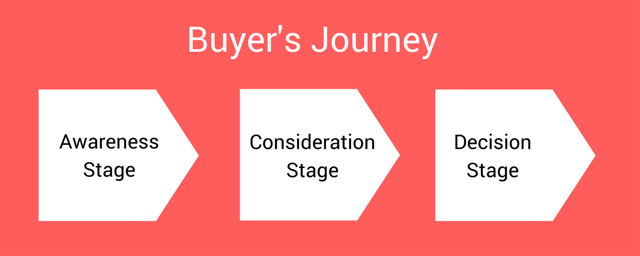
Once keyword research and brainstorming is underway, it is important to layer in the buyer’s journey. This could also be characterized as the member’s journey, the event participant’s journey, etc. Basically, it’s categorizing where the user is in their experience with your brand. They first begin at the awareness stage. Here they are not yet problem solving, and they are not solution shopping, they are asking questions to discover what problem they are having. Content for the user that is at the awareness stage is completely different than when they are in the decision stage. In between awareness and decision is the consideration stage. Once in the consideration stage, it is great to go into solution oriented content. Finally, content that talks about your brand and specifically about your organization should be targeted to the user when they are at the decision stage.
Once you have conducted keyword research, and categorized keywords, phrases, and topics into categories based on the buyer’s journey, it is important to draft your personas. These are carefully crafted stories about your audience that characterize a specific lead that you want to target. In these personas there can be job title, salary range, family size, pain points and challenges, and lastly 2-3 paragraphs that tells the story of your persona. Once you have these three pieces in place you are in a strong position to create relevant, targeted, user-friendly content that meets the buyer where they are in their digital footprint.
This leads me to my last point in tying it all together with marketing automation. Using a robust platform such as marketing automation in conjunction with SEO combines the many manual processes of lead generation that are inherent in SEO with automation for greater revenue. With marketing automation it is easy to incorporate all of your SEO efforts. Social media can be streamlined and monitored, so content can be distributed for optimal engagement. Landing pages and blogs are easily optimized with meta descriptions to quickly signal to users at a glance what your topic is about. Finally, the automation of sending out emails that point to lead generating landing pages and articles can be set up with programs that trigger based on an action taken that you choose.
While search engine optimization sounds super technical, it can simply be categorized as inbound marketing, or content strategy in today’s market. This is because content and SEO go hand in hand. Creating great, relevant, targeted content that is useful to your audience is a full-time job for many. What marketing automation does is it takes the anonymous web visitors known through Google Analytics and gives each individual a name and a digital footprint. It empowers the SEO practitioner and content creator with greater ability to take the next step from a marketing qualified lead (MQL) to a sales qualified lead (SQL) and closes the loop to creating greater revenue.
If you found this article helpful and would like to learn more, check out my webinar on the subject.

Share


Do you think marketing automation is primarily used for lead generation? If so you are certainly not alone, many marketers do. The truth is marketing automation can do much more. You can and should leverage this technology for brand marketing and customer marketing as well. Marketing automation can be used at every stage of the customer lifecycle. By using the power of data driven strategies derived from a marketing automation platform you can drive leads, build your brand, and deliver an outstanding customer experience. We have found an article at Act-On, written by Cindy Collins-Taylor, that explains what benefits marketing automation has to offer, not only for lead generation strategies, but also for branding and customer marketing strategies. This article will help you understand what marketing automation can do and how to get the most out of your marketing automation palform.
Share
April 28th is approaching fast and Verizon customers who haven't yet migrated to AOL will have their email accounts closed.
What does this means to association marketers?
- Reach out to these constituents now using your email/marketing automation platforms and request that they log into your membership portal to supply you with an updated email address.
- Expect more Verizon email address bounces.
- Expect more Verizon email addresses to be resolved to being invalid/ineligible/undeliverable.
You can read more about this on the Return Path Blog.
Share
In a digital world it is integral to always be in the know. But how does one find the time to scour the web for the latest and greatest while holding down a 9-5? I have two words for you, Google Alerts. Google Alerts will send you e-mail notifications about anything and everything. Want to know every time your company is talked about on the web? Simply program an alert and get informed the moment it happens! Here are three powerful ways to use Google Alerts as a tool:
Share
Marketing automation is technology that allows you to automate and measure your marketing activities and strategies. It enables you to attract more leads, nurture those leads, and convert them more quickly into customers. The infographic below illustrates 9 benefits of marketing automation that will save you time and money.
Share

The most common model of marketing in associations has inherently been multi-channel marketing. Nearly every organization and association practices multi-channel marketing, interacting with users on different digital channels and devices. Multi-channel marketing has a distributional approach of sending out information to users in a multitude of ways. Multi-channel marketing, although a traditional method of marketing, does not allow organizations to understand how the user connected, how to measure each interaction, or if the user had multiple touchpoints. Because of these shortcomings there has been a fundamental shift in mindset to focus on the user, also known as the U.
Share